
Jurij Tokarski
Discovery Is Now Nine One-Click Tools
Eight AI chats became nine short forms, each with one AI call and a one-page result. A privacy question in another chat started it; session data finished it.
A visitor in my 404 page's AI chat asked where the privacy policy was. They worried that a free-text chat might be storing private or personal data.
Fair question. It kept what visitors typed.
That question started the change that turned Discovery, my set of free tools for software founders, from chats into one-click tools.
The First Split Kept the Chat
Discovery had been split once before. In March I wrote that nobody finishes a 15-minute AI interview, and split it into eight tools, one deliverable each.
My plan was a shorter interview, with some of my own knowledge built in so the tools would argue back.
So each tool was still a chat. Chat is still the native format for AI products, and the first version had been one too.
Every Form Was a Privacy Issue
The 404 question made me look at every place on the site that took free text from strangers. Each one was a privacy risk, whether anyone used it or not.
The 404 chat became a plain page. The principles chat went too; almost nobody had used it. That left Discovery as the last chat standing.
At first I only thought Discovery probably needed another iteration. Then the other signals lined up.
Nobody Finished the Shorter Chats
The first signal was the data. The sessions stored from May to September told the story: none went past its first tool, and most stopped four or six messages in.
Shorter chats lost founders the same way the long interview had.
Founders Came for the Result
The second signal was in the code. The March post said the deliverable is the unit, and the code agreed: about 2,900 of the 12,200 lines in Discovery existed only for the interview. The renderers, the PDF and the email already worked on finished results.
A founder who came for a lean canvas still had to talk their way to it.
One Call Can Be Checked
So my brief on October 5 had three steps: the user provides data, one AI call, a formatted and structured result.
One call returns one structured answer, and code can test, cap and price it before anyone sees it. A chat's answer depends on every turn before it.
Nine Tools, One Form Each
Discovery v5 went live on October 7 with nine tools: the eight, plus a new Idea Generator.
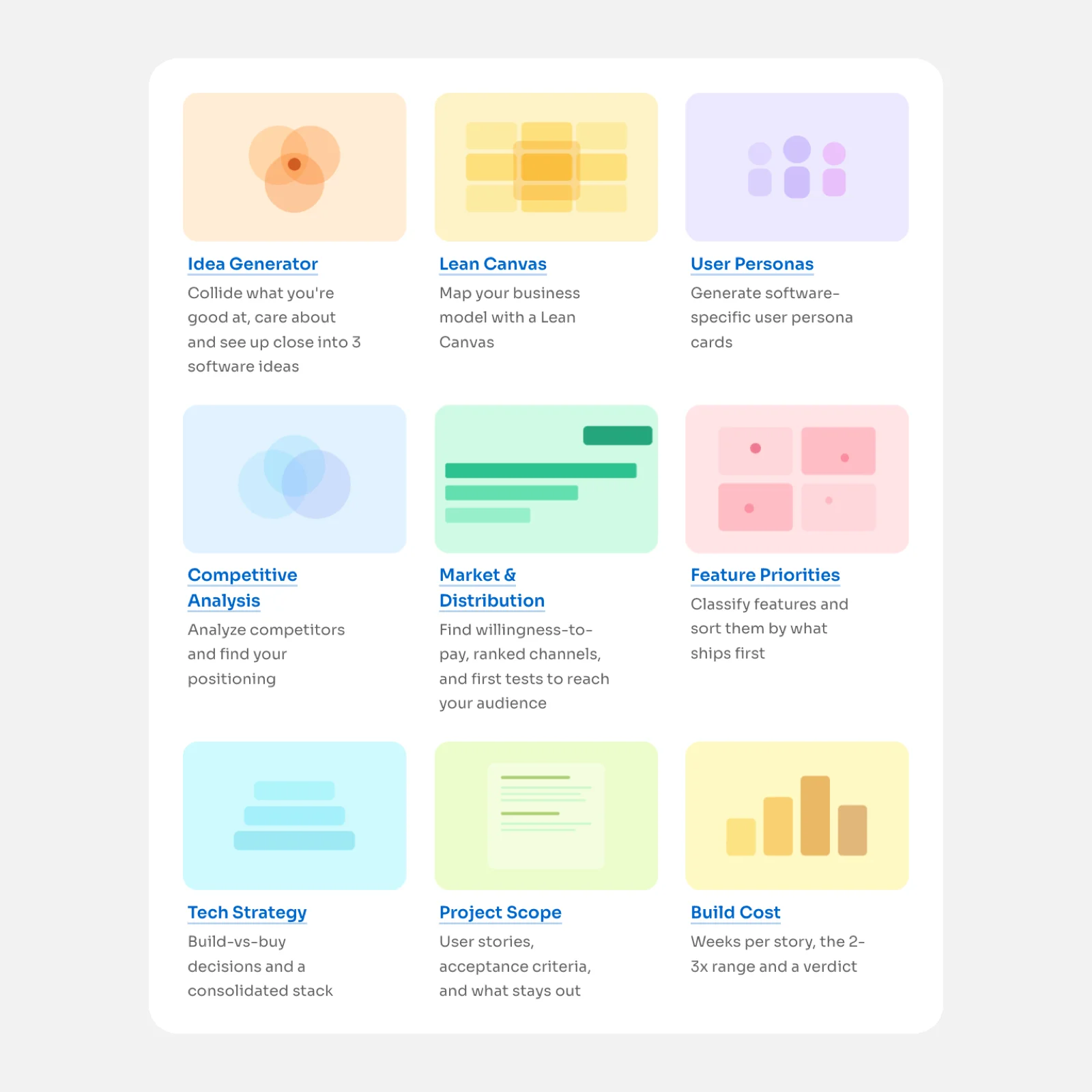 The hub: nine tools, one card each.
Each tool starts with one short form: every question on one screen, one run button.
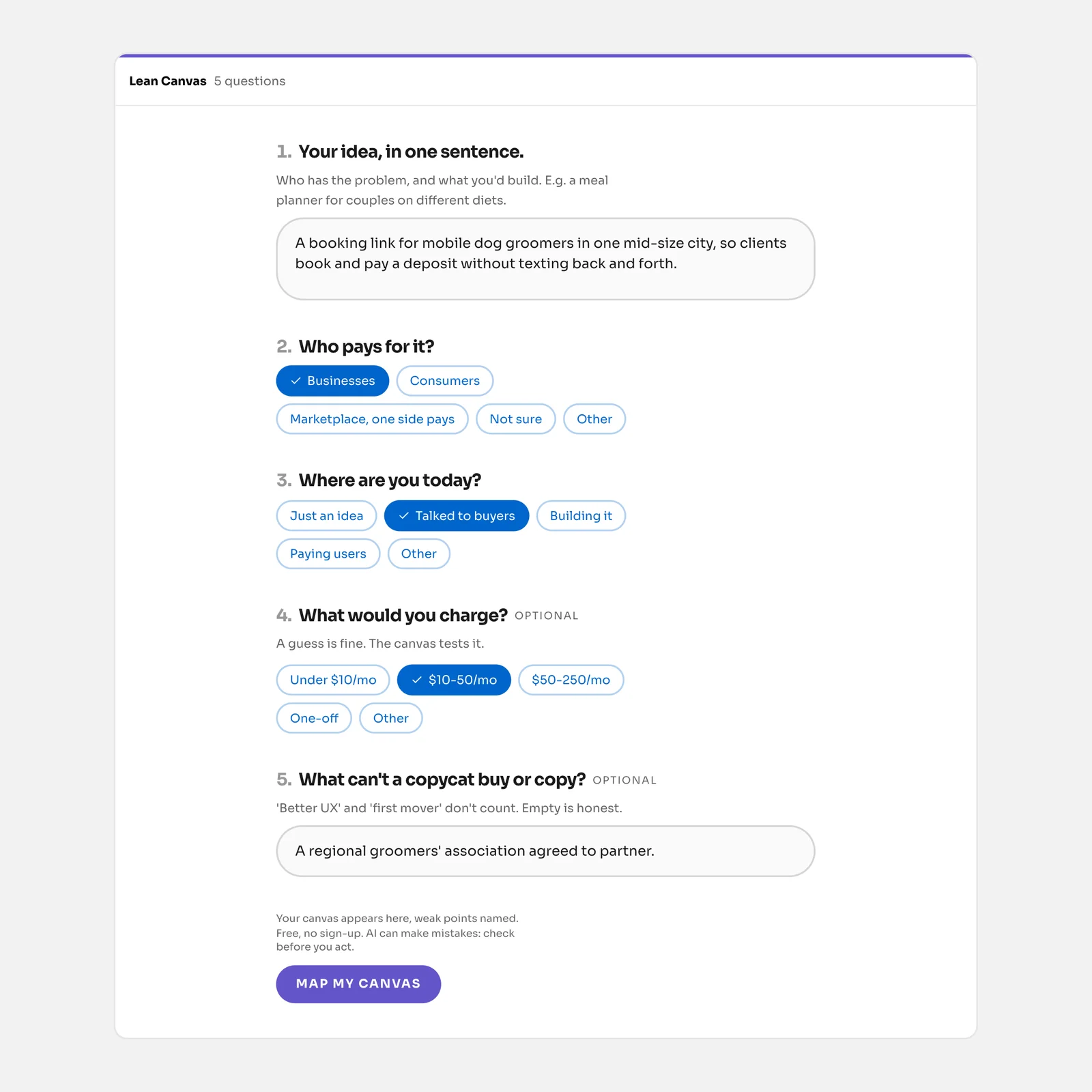 Lean Canvas asks five questions. Two are optional.
The run is one Claude Sonnet call that returns structured output.
 One call while the founder waits: answers, canvas, check.
Code renders that output as a one-page result, the same on screen and in the PDF, with a Markdown copy.
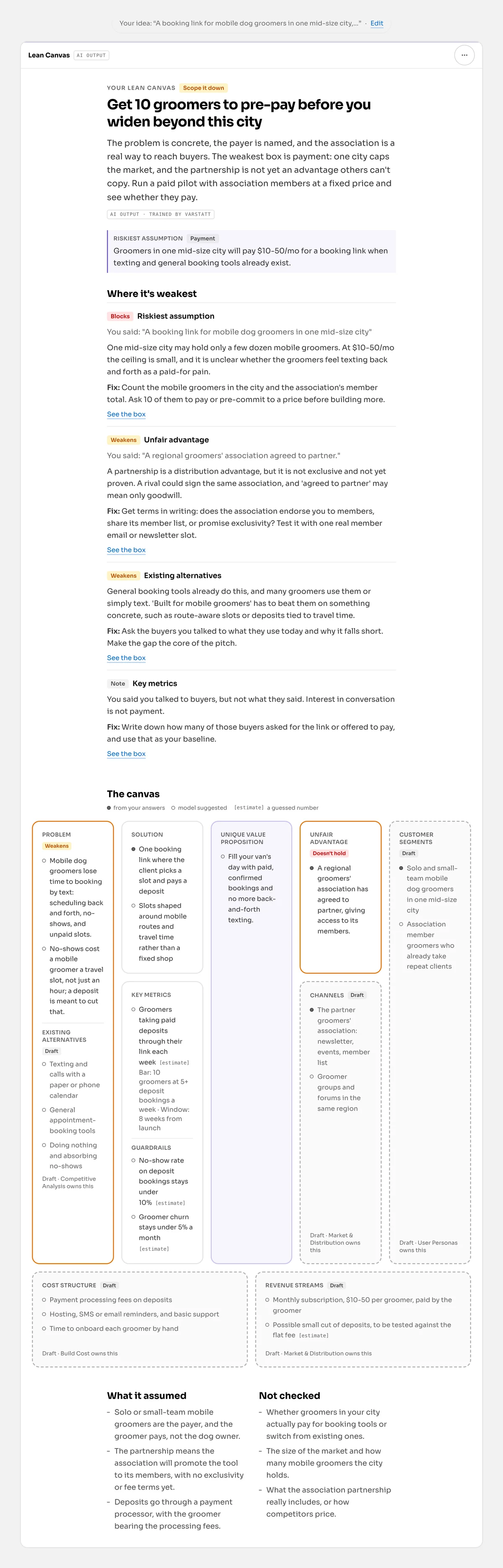 The full result: a verdict first, then where the idea is weakest, then the canvas itself.
Answers go to the model for the run and are not stored. Code also guards what comes back: if the model adds a sales line, like my name or "hire me", the run fails and shows the sample instead.
A Test That Fills the Form Like a Founder
Guards need proof, so every tool has an end-to-end test. It opens the tool in a real Chrome, fills the form like a visitor, runs it and judges the result.
It screenshots every step and downloads the PDF, JSON and Markdown. Then it checks what the model wrote: caps, quotes, banned phrases, English only.
On October 10 it ran all nine tools against real model calls, around one made-up idea: a booking link for mobile dog groomers. A result took 9 to 24 seconds and cost about 4 cents.
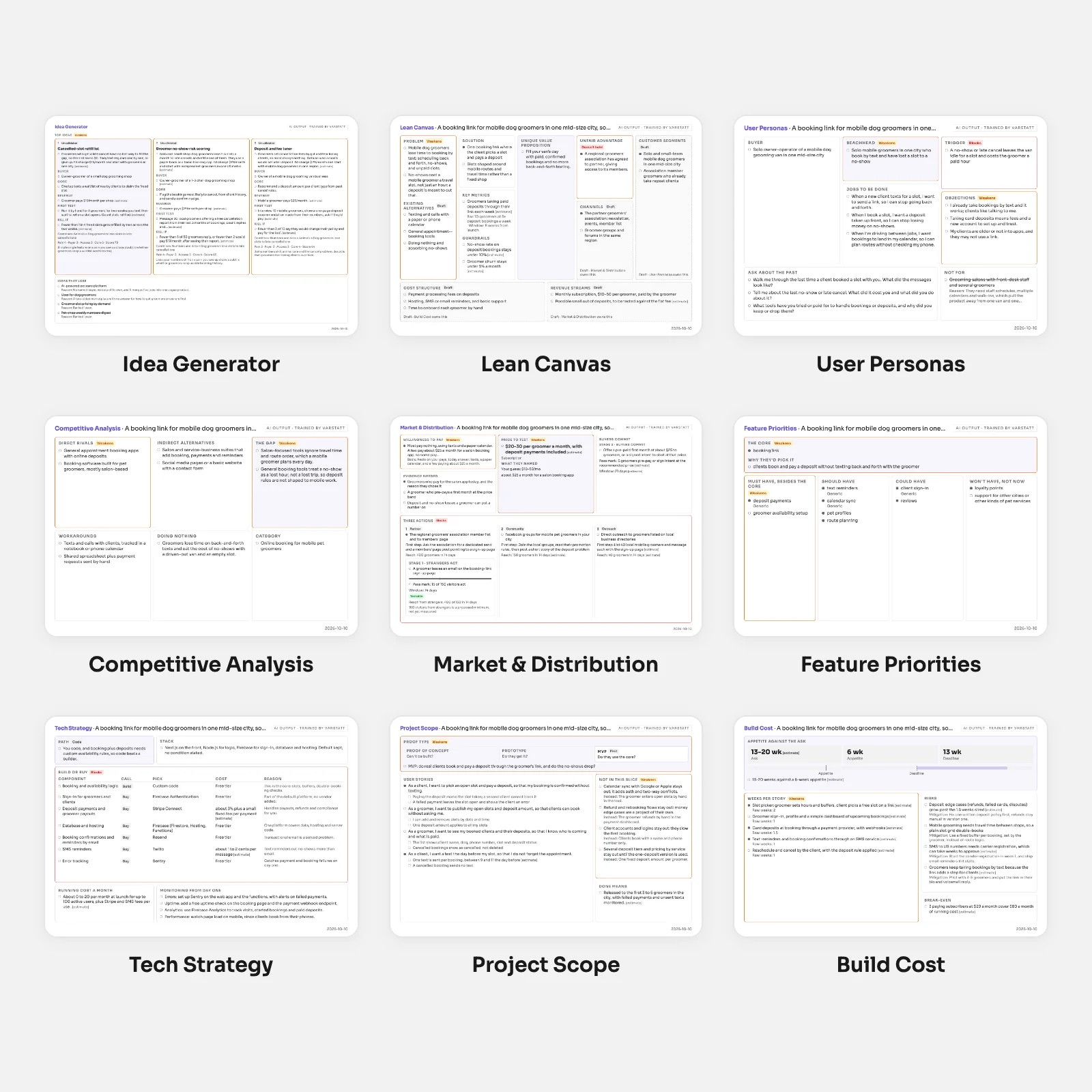 One idea through all nine tools: nine one-page PDFs from real model calls.
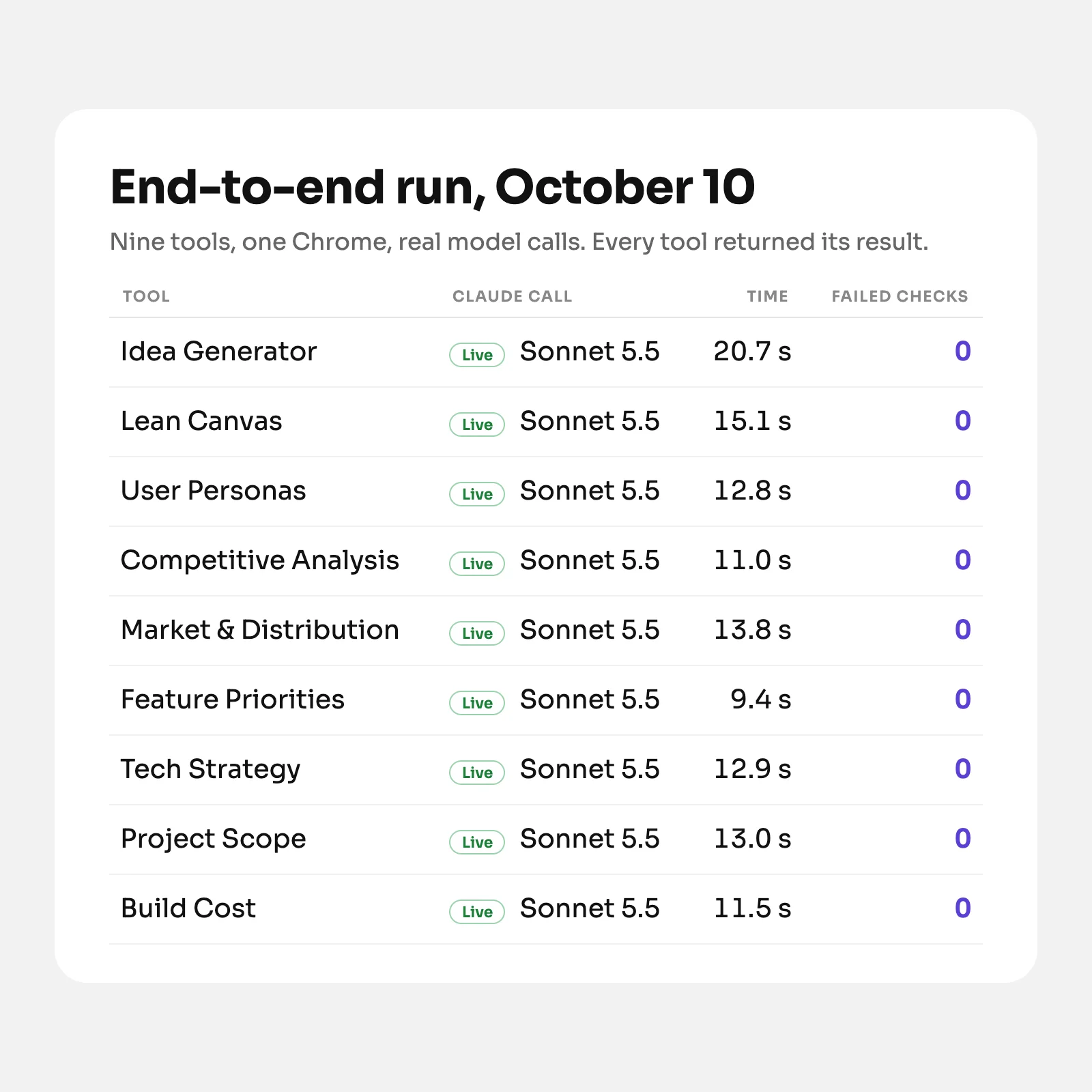 Nine live runs, no failed check.
The loading and result screenshots above come from those runs too.
What It Doesn't Do Yet
The tools don't chain yet: each one stands alone for now. It's also too early for a usage verdict, since search data for the new pages comes in over the next weeks.
The Second Split Removed the Chat
The March post said to build around the deliverable. I did it for the pages and kept the conversation.
A privacy question took the conversation out, and the data said nobody would miss it.
If the visitor came for a document, a form gets them there in one click.
Try it: varstatt.com/discovery
Subscribe to the newsletter:
About Jurij Tokarski
I run Varstatt and create software. Usually, I'm deep in work shipping for clients or building for myself. Sometimes, I share bits I don't want to forget.
x.comlinkedin.commedium.comdev.tohashnode.devjurij@varstatt.comRSS