Delivery · Principle 12 of 33
Async Updates
Progress is communicated asynchronously, not in meetings.
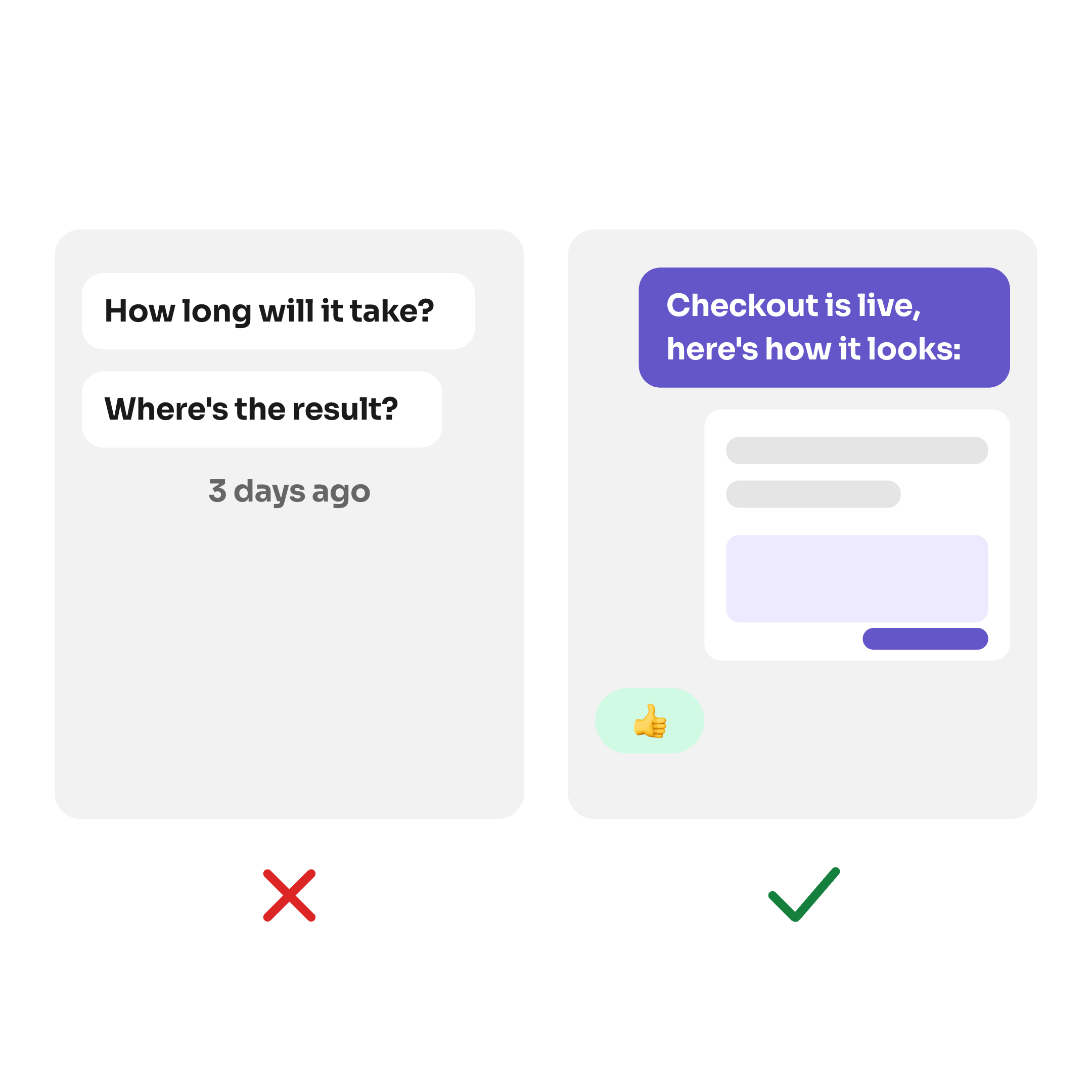
Writing is the delivery communication layer. Every work session produces a written artifact — not a meeting, not a call, not a Slack ping asking "how's it going?"
Write After Every Session
After each work session, the developer posts an update. What got done. What's next. What decisions were made and why. A screenshot, a link to the deployed feature, a short paragraph of context. Simple.
The client sees progress continuously. No waiting for a weekly status meeting. No "any updates?" emails because the update is already there. The async update replaces the status meeting entirely.
What Goes in an Update
Keep it concrete. "Implemented the checkout flow. Stripe integration is working in staging. Still need to handle the webhook for failed payments — doing that next." Link to the deployed change if possible. Attach a screenshot if it's visual. Flag blockers explicitly: "Blocked on: need the production API key from the client."
Avoid vague updates. "Worked on the backend" tells nobody anything. Name the thing. Show the thing.
Decisions Get Captured in Real-Time
When the developer documents a decision right after making it, the reasoning is still fresh. "Went with approach X because Y" — that context lives in the thread forever. Six months later, someone asks why — the answer is already there. No reconstructing half-remembered conversations.
This also protects both sides. When the client asks "why did we do it this way?", the answer is already in the thread. No defensiveness needed. Just a link.
The Compound Effect
Updates accumulate into a project history. After three months anyone can scroll back and see every decision, every feature shipped, every blocker resolved. That's more useful than any retrospective. It's real-time documentation that writes itself as a side effect of working.
Next: Quality Gates
Isn't a Solo Developer a Bus Factor of One?
Yes. Fix the handover, not the headcount: access, documentation, history and exit make the next developer's first day cheap.Full answer·2 min readWhat a Freelance Web Developer Actually Charges
My actual pricing model, why hourly billing is broken, and what clients should expect when hiring a freelance web developer in 2026.Full answer·6 min readHow Does Async Collaboration Work Without Daily Meetings?
Async-first communication replaces status meetings with written updates, full transparency, and documentation that builds itself.Full answer·2 min read