Diligence · Principle 17 of 33
Observe and Improve
Real data drives continuous improvement.
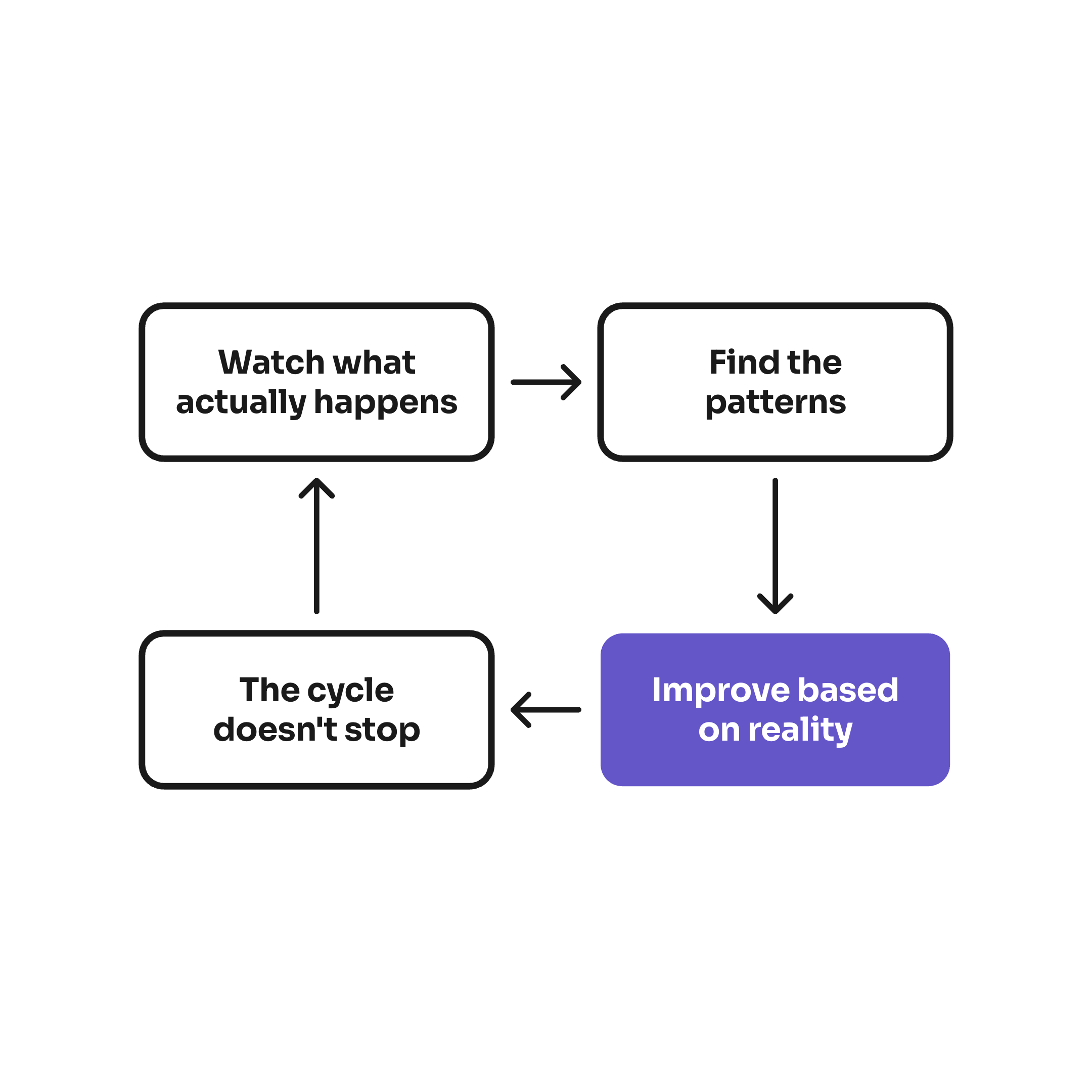
Software gets built on assumptions. It gets improved on reality. Those are two very different inputs, and only one of them is honest.
Watch What Actually Happens
Users do unexpected things. Always. The happy path the developer designed? Maybe half of people follow it. The other half find creative ways to stress the assumptions — submitting forms with data nobody anticipated, combining features in ways nobody considered, hitting edge cases nobody knew existed.
Don't watch what was expected to happen. Watch what actually happens. There's a difference, and it matters.
Find the Patterns
One user hitting an error is noise. Ten users hitting the same error is a pattern — and a pattern means something is wrong with the software or the UX, not the user.
Usage data tells the same story. Feature X gets hammered daily. Feature Y sits untouched. That's a pattern too. Maybe X needs optimization. Maybe Y needs to be cut. A page that loads slow in one specific scenario but fast everywhere else? That's not random — it's a particular query, a particular data condition, something real and specific the developer can fix.
Data reveals what assumptions miss.
Improve Based on Reality
The client says users need feature Z. The developer checks the analytics. Nobody uses feature Y, which does something similar. Before building Z, the question is: has anyone validated this need? That's a better question than "how long will it take?"
Performance feels sluggish. The developer checks monitoring. 95% of requests are fast. 5% are slow — all hitting one specific database query. Optimize that query. Problem solved. No guessing.
Bug reports seem scattered. The developer digs into the error logs. Every single error comes from mobile Safari. Not random. Browser-specific. Fixable.
Reality-based improvements beat assumption-based development every time.
The Cycle Doesn't Stop
Build. Deploy. Observe. Analyze. Improve. Deploy again. That's the loop. Not "build, deploy, done."
Software that doesn't evolve dies. Markets shift. User behavior changes. Competition moves. Without observing and improving, it's just hoping — and hope isn't a strategy.
What It Actually Takes
Humility. Assumptions will be wrong. That's not a failure, it's the nature of building things. Adapt.
Curiosity. When users behave unexpectedly, ask why. What does this pattern mean? What are they actually trying to do?
Action. Observing and analyzing accomplish nothing on their own. The loop only closes when the improvement ships.
Next: Pause, Not End