Discovery · Principle 2 of 33
Find the Core
The essential capability gets built first — everything else waits.
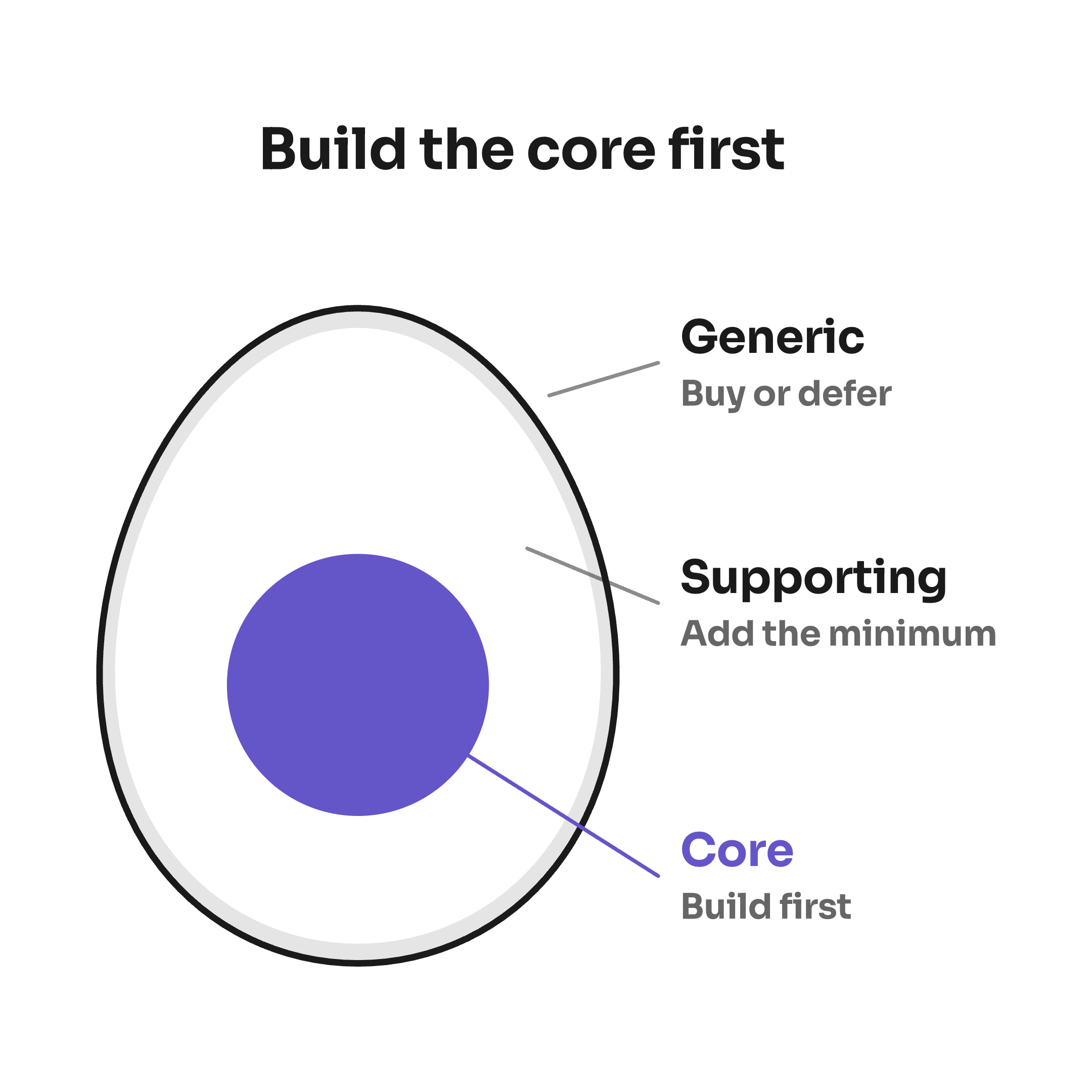
Everything can't be equally important. The hardest part of any project isn't building — it's figuring out what actually matters.
The Feature List Trap
When scoping something new, the client provides a list: authentication, dashboard, notifications, export, integrations. That's not a vision. That's a backlog with no spine.
The core domain is the single capability that creates competitive advantage — the reason the thing exists. "This app helps recruiters find qualified candidates by analyzing resumes against job requirements using AI." That's a core. Everything else either supports it or doesn't belong yet.
The dashboard that presents matching results is a supporting domain. It enables the core to be useful, but it's not the value itself — swap it for a different UI and the product still works. Authentication? Notifications? Generic domains. Commodity. Buy them or defer them entirely.
Build the core first. Add the minimum supporting features to make it usable. Buy or defer everything generic.
Existing Software Is Messier
Ongoing projects don't have the luxury of a clean slate. There's debt, feature requests, bugs, and performance issues all competing for attention at once.
The client still can't do everything. The question is the same: what's the immediate priority that unlocks the most business value right now? Sometimes it's a new feature. Sometimes it's a critical bug costing customers. Sometimes it's a performance fix that unblocks everything else.
But it's one thing. Pick it, execute it, move to the next.
Where Projects Waste Effort
Most teams spend the majority of their time building supporting and generic domains from scratch — user management, payment flows, file storage, email delivery. Things that have been solved a hundred times.
That's not competitive advantage. That's operational necessity. The market doesn't reward anyone for writing their own email queue.
Every hour spent on generic infrastructure is an hour not spent on the thing that actually differentiates the product.
The Forcing Question
Ask it directly: if only one thing could be built, what creates the most value?
That's the core. Start there.
Next: Appetite, Not Estimates
Which Engineering Principles Matter for a Startup?
The ones that let you ship every week: build only what is worth building, fix the budget, flex the scope, and finish one task at a time.Full answer·5 min readWhat Do Most Founders Get Wrong About Building AI Products?
AI is a tool, not a product. What makes a product valuable is domain expertise. Without it, AI products are generic and replaceable.Full answer·2 min readWhen Should You Build Custom vs Buy Off the Shelf?
Default to buy. Build custom only when the custom part IS your product's value. Everything else is glue — and glue should come off the shelf.Full answer·1 min readWhat Makes a Good Project Brief?
A good brief describes the problem and the business, not the deliverable. Bad briefs say 'build me a mobile app.'Full answer·1 min readHow Do You Go from Idea to Working Product?
The real path from idea to product is discovery of the problem first, then solution. Most founders skip this entirely.Full answer·2 min read