Delivery · Principle 14 of 33
Default Stack
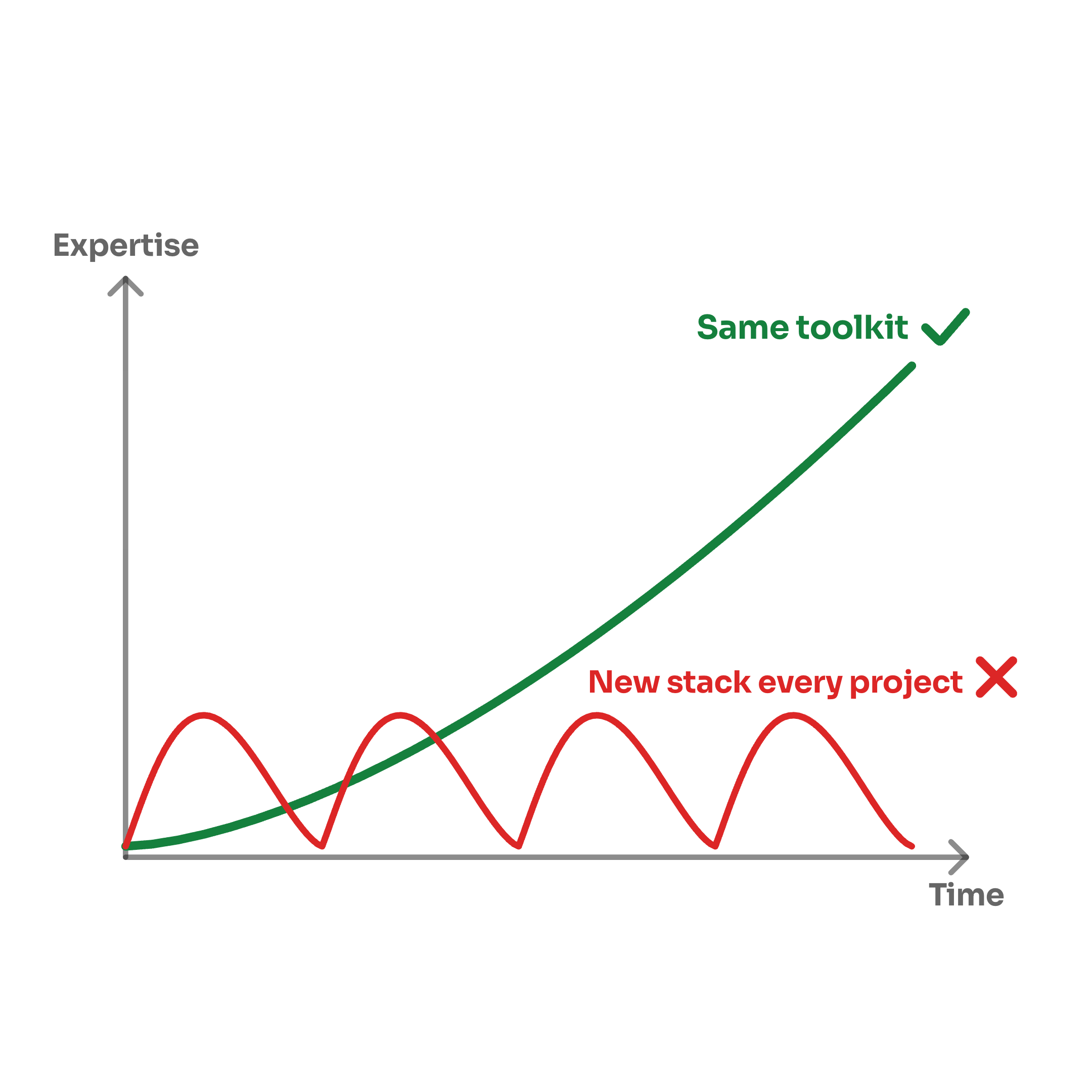
Deep expertise in familiar tools beats starting fresh each time.
Would a client trust a mechanic who asks what tools to use to fix the car? Of course not. The client expects the mechanic to have their own tools, know them deeply, and get the job done.
But if the client comes with suggestions — a specific part, a preferred brand — a good mechanic adapts. They expand their default stack with the client's input.
A default stack is what the developer uses when building from absolute scratch, when the client has no existing infrastructure or opinion. Without one, tool decisions happen on every project instead of building expertise.
Within the default stack the developer accumulates everything: know-how, assets, patterns, scripts, shortcuts. They know what works. They know the pitfalls. They ship faster because they've solved these problems before.
One Language, End to End
The strongest default stacks use one language across the entire stack — frontend, backend, infrastructure. Same mental model, same tooling, same debugging. The specific platforms and frameworks follow the consolidation principle: fewer moving parts, one coherent toolkit.
In Varstatt, that language is JavaScript and TypeScript everywhere. This stack builds 80% of modern web applications for almost any niche, any usage. Full-stack, end-to-end product development from a single coherent toolkit.
How Far Is Too Far
No default stack covers everything. Clients bring existing infrastructure, preferred tools, specific requirements. The question isn't whether to adapt — it's how much adaptation the developer can absorb before the expertise advantage disappears.
Think of it as vector distance — how far is the client's needed stack from the developer's default? A different cloud provider with the same language and patterns? Close enough. Same principles, slightly different tools. A completely foreign language with an unfamiliar backend? That's far. Probably not the right mechanic.
Of course the developer adapts. But adaptation has a cost. The further from the default, the less benefit from years of accumulated expertise. At some point the distance is too great and the developer is learning on the client's dime. That's not honest.
Consolidation isn't stubbornness. It's expertise compounding over time.
Next: Diligence
Which Engineering Principles Matter for a Startup?
The ones that let you ship every week: build only what is worth building, fix the budget, flex the scope, and finish one task at a time.Full answer·5 min readHow Should a Startup Choose Its Tech Stack?
There is no best stack. There's a best stack for your specific situation. Match the stack to business reality, not trends.Full answer·2 min read