Philosophy · Principle 29 of 33
Hours Are Wrong
Hourly billing misaligns incentives — fixed rates fix it.
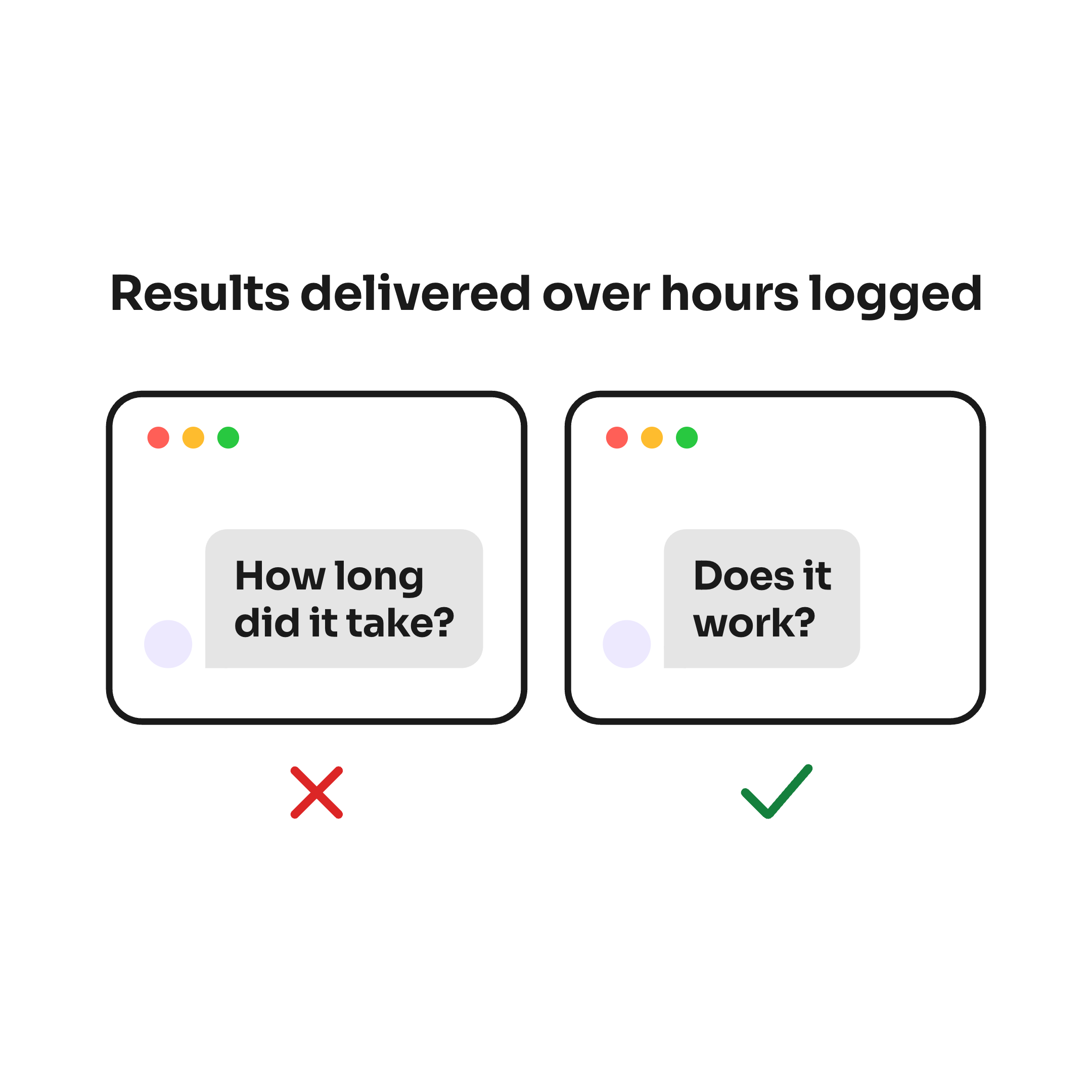
Hourly billing is productivity theater. It measures the one thing that doesn't matter — time — and ignores the one thing that does: whether the work delivered value.
Ten hours of bad code is worse than two hours of good code. The hours don't tell anyone which one they got.
What Hours Actually Measure
Hours measure presence. Nothing else. They don't measure quality, judgment, or whether the problem got solved. They don't tell the client if the developer was sharp or stuck in circles.
A senior engineer might solve in an hour what a junior takes ten hours to fumble through. Under hourly billing, the senior earns less for delivering more. That's not a pricing model — it's a punishment for expertise.
The client doesn't care how long it took. The client cares whether it works.
The Incentive Problem
Hourly pricing creates a perverse incentive: work slower, earn more. Work faster, earn less. Every efficiency gain comes out of the developer's pocket.
It also requires surveillance to function. Time tracking software, activity logs, screenshot monitoring. The client isn't hiring a professional — they're babysitting one. That's not a working relationship. It's a power struggle dressed up as accountability.
How Fixed Rates Fix This
A fixed rate regardless of hours spent flips the incentive: deliver value efficiently, and the work is done. Solve the problem in ten hours? Great. Takes forty? Also fine. No logging required.
There's no time tracking to game. No reason to pad hours or drag work out. The only question is: did the developer ship what was promised?
Transparency Without Surveillance
No time tracking doesn't mean no visibility. The client sees exactly what's being built — task updates, commits, deployed features. The client just doesn't see how many hours each piece took.
That's fine. Hours don't matter. Results do.
What Makes This Work
It requires trust in both directions. The client trusts the developer isn't slacking. The developer trusts the client won't treat a fixed rate as a license for infinite scope.
Weekly delivery creates that trust naturally. The developer delivers value, the relationship continues. The developer doesn't deliver, the client cancels. No surveillance needed when accountability is built into the model.
Next: Consolidation
What a Freelance Web Developer Actually Charges
My actual pricing model, why hourly billing is broken, and what clients should expect when hiring a freelance web developer in 2026.Full answer·6 min readWhat's the Difference Between Freelancer, Agency, and Retainer?
Three service models with different incentive structures. The key insight: productize the workflow, not the service.Full answer·2 min readHow Much Does It Really Cost to Build an MVP?
The $5K-$500K ranges you see online are mostly noise. They reflect service model and overhead, not code quality.Full answer·2 min read