Philosophy · Principle 32 of 33
Solo Developer Model
One developer, full stack, AI-augmented.
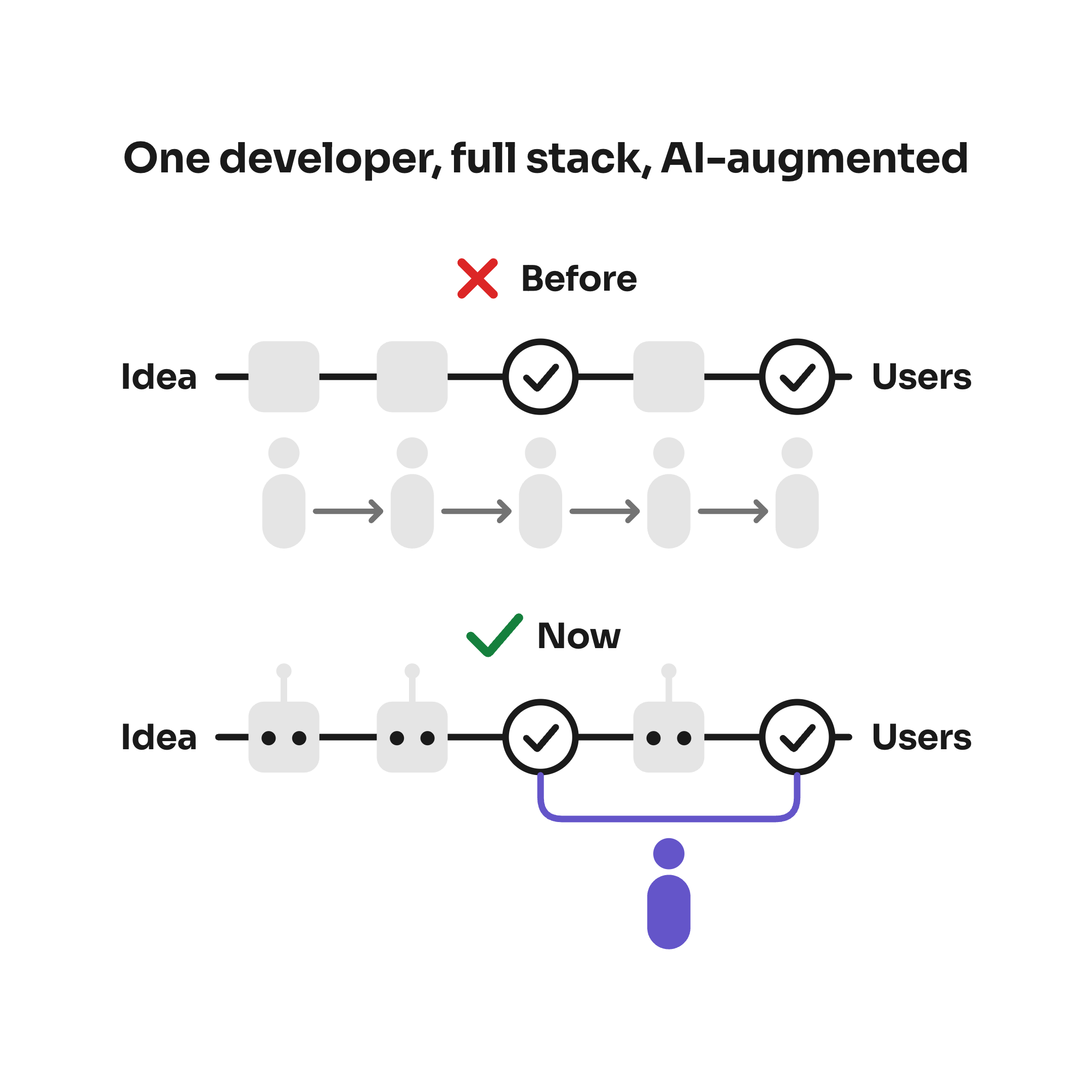
The AI era changed the math. A solo developer with modern AI tools can rival the output of a small team from five years ago. For most startup projects, this is fully enough and dramatically more cost-effective.
Why One Developer Works
The advantages are concrete. No context switching between team members. No handoff documents. No standup meetings to synchronize. No merge conflicts from parallel work streams. No "I thought you were handling that" conversations. One person holds the full context of the entire system in their head.
A modern product engineer can deliver and iterate across the full software development lifecycle. Frontend, backend, infrastructure, deployment, monitoring. For most projects, the pace is exactly right for the business to absorb it. The developer ships, the client integrates, the developer ships again.
Other principles follow naturally: WIP limit of one, scout rule, no handoffs, no coordination overhead. One developer simplifies everything.
When It Breaks
When the startup scales. When one developer can't cover the surface area anymore. When the client needs three features shipped simultaneously. This is the natural limit.
And that's fine. When it breaks, the developer adapts. Assemble a small team and manage it. Bring in a designer. Join the client's existing team with a specific area of responsibility. The arrangements get custom, harder to templatize — but the developer handles it.
Some clients need the developer to be the entire tech team. Others need one specialist in a bigger org. The solo model is the default, not the dogma.
The Sweet Spot
For most engagements — early-stage products, MVPs, ongoing iteration on established apps — one developer with AI tooling, deep stack expertise, and a proven process delivers more than a team of three with coordination overhead.
Solo isn't a limitation. It's a competitive advantage — until it isn't. Know when that moment comes.
Next: Client Owns Everything
Isn't a Solo Developer a Bus Factor of One?
Yes. Fix the handover, not the headcount: access, documentation, history and exit make the next developer's first day cheap.Full answer·2 min readWhat a Freelance Web Developer Actually Charges
My actual pricing model, why hourly billing is broken, and what clients should expect when hiring a freelance web developer in 2026.Full answer·6 min readHow Much Does It Really Cost to Build an MVP?
The $5K-$500K ranges you see online are mostly noise. They reflect service model and overhead, not code quality.Full answer·2 min read