Discovery · Principle 5 of 33
Context Over Purity
Pragmatic decisions beat perfect theory.
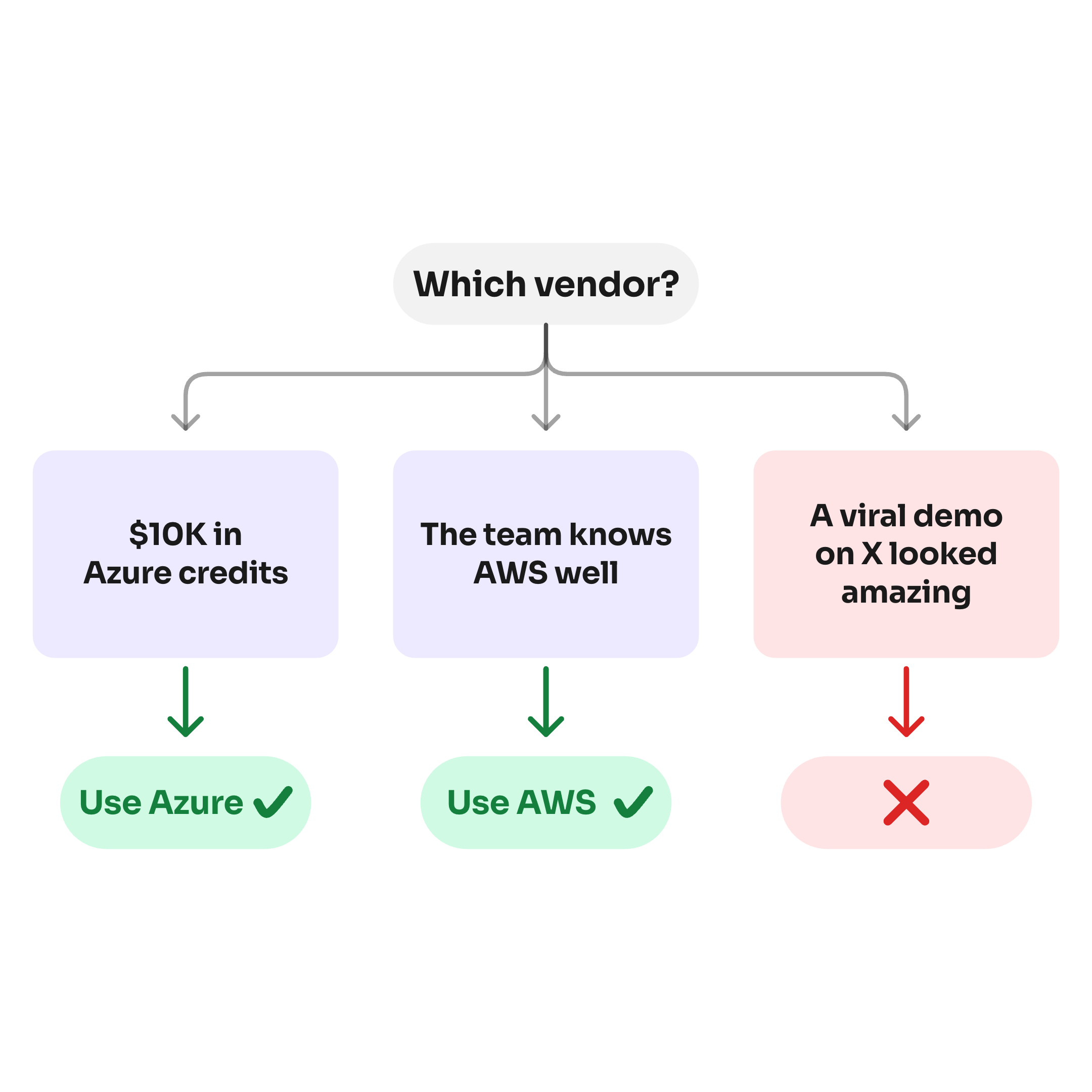
The best technology stack is the one that fits the client's actual constraints. Not the one that's theoretically pure. Not the one that's fashionable on Hacker News this month.
Business Constraints Win
The client has $10K in Azure credits from a startup program? Use Azure. The client's team knows AWS well? Use AWS. The existing infrastructure runs on Google Cloud? Stay there.
None of these are wrong choices. They're right business decisions. Yes, the developer has preferences. Yes, some stacks are objectively better for specific cases. But context beats preference every time.
Fewer Moving Parts
When making technology choices, bias toward fewer services and fewer integrations. Every additional tool is another thing to learn, maintain, and debug. During discovery, this means asking: "Can the platform already chosen handle this, or is something else truly needed?"
Most of the time, the chosen platform handles it. The consolidation argument runs deeper than a discovery decision — it's a philosophical position explored fully in the Philosophy section.
The Default Stack Isn't an Accident
A good default stack is predictable, well-documented, and handles common cases without drama. The developer adapts when business needs require it, and defaults to proven simplicity when they don't.
In Varstatt, that's React, Node.js, and Firebase — covering the vast majority of what clients actually need. Same language on the front end and back end. A unified mental model. A massive ecosystem. Not because JavaScript is the best language ever invented, but because this stack is proven at scale by thousands of teams.
How to Have the Conversation
Lead with reasoning, not dogma. "The recommendation is X because of these constraints. If the client has strong preferences for Y, the developer can work with that — here are the tradeoffs."
No lectures. No dogma. Context-appropriate choices with clear reasoning.
Next: Saying No
Which Engineering Principles Matter for a Startup?
The ones that let you ship every week: build only what is worth building, fix the budget, flex the scope, and finish one task at a time.Full answer·5 min readHow Should a Startup Choose Its Tech Stack?
There is no best stack. There's a best stack for your specific situation. Match the stack to business reality, not trends.Full answer·2 min read