Sort Features Into What Ships First
Classify every feature as core, supporting, or generic, then phase the list into MVP, Growth, and Scale by business impact.
Free, no setup, 2-3 minutes.
How It Works
Bring Your Feature List
Paste a feature list, or describe the product and the agent will extract features. 8-15 is the sweet spot. Past 25 it'll stop you and ask you to group into capabilities first.
The Agent Classifies and Scores in One Pass
Domain bucket (core, supporting, generic) and business impact (1-10) for every feature, presented together so you see the shape of the product, not one row at a time.
Push Back, Get Pushed Back On
If you land on 4+ core features, the agent forces a ranking — if everything is core, nothing is. If you want to build auth custom, expect resistance. You keep the final call; the agent flags the risks on every override.
MVP, Growth, Scale Phasing
Core ships in MVP with the supporting features it needs to function. Growth gets retention work plus a trigger ("when you've validated users want the core product"). Scale gets enterprise and performance work. The matrix becomes the scope you hand to a developer.
Where Feature Priorities Sits in Discovery
Step 5 of 8 in product discovery. Comes after Market & Distribution and feeds straight into Tech Strategy.
Use this when: Your feature list is longer than your budget and everything feels like a must-have.
Who it's for: Founders staring at a backlog who need a defensible cut before scoping a build.
Auth and Billing Are Not Your Moat
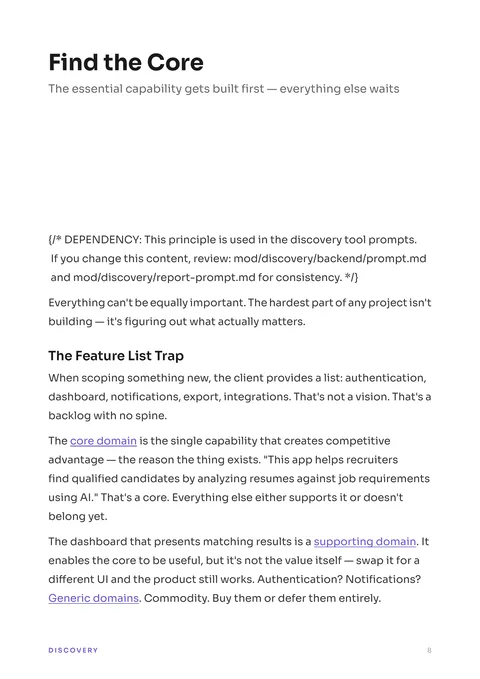
I've watched founders spend three weeks rebuilding what Stripe and Auth0 already solved. The agent splits your list into three buckets — core (the one thing people pick you for), supporting (necessary plumbing like user management or admin), and generic (auth, payments, email, file storage, search). Generic always gets bought. Always. Stripe has 3,000 engineers on payments — you have one.
Important Is Not the Same as Core
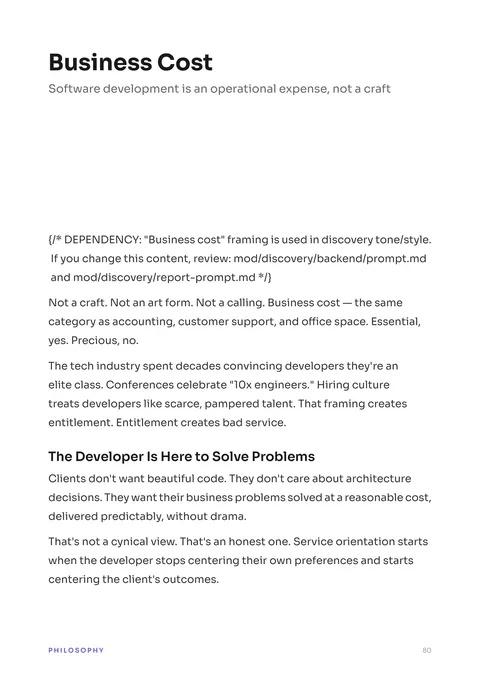
A feature can be expensive, load-bearing, and still not why anyone chooses you. The agent forces the test: finish the sentence "the reason someone picks us over the alternative is ___." Whatever fills that blank is core. Everything else has a different bucket. That's the line founders blur, and it's the line I make the agent hold.
MVP, Growth, Scale — Phased by Impact
Once the buckets are clean, phasing falls out of the prioritization matrix automatically. MVP is core plus the supporting features core depends on. Growth is retention and expansion work, with a trigger for when to start it. Scale is optimization for past-early-adopters. No quarterly roadmaps, no arbitrary dates — entry criteria instead.
Frequently Asked Questions
A feature prioritization matrix is a structured way to decide which features ship first when your list is longer than your budget. The standard product prioritization framework here scores every feature on two axes — domain bucket (core, supporting, generic) and business impact — then phases the list into MVP, Growth, and Scale. Core gets built. Generic gets bought. Supporting fills the gaps core needs to function. The matrix is the artifact you hand to a developer instead of an unranked wishlist.
You don't. Most products have 1-3 core features. If you mark 4+ as core, the agent rejects the list and forces a ranking — "if you could only ship three features and nothing else, which three?" I built that hard stop in because I've watched too many founders pad the core box with everything that feels important and then ship nothing actually differentiated. Six months later a copycat wins on the one thing they should have owned.
RICE (Intercom, 2016) and MoSCoW (Dai Clegg, 1994) score features against a rubric. They don't surface the build-versus-buy line. This tool classifies first, then phases — so "buy auth, build the matching algorithm" comes out as an obvious answer instead of a debate.
Core is your competitive advantage — the reason someone picks you over alternatives. Supporting is the plumbing that enables core but isn't unique (user management, admin panels, notifications). Generic is solved-problem territory (auth, payments, email, file storage, search). The classification feeds straight into Tech Strategy.
It'll challenge them. Auth and payments get flagged as buy-not-build. Supporting features get deferred if core doesn't need them in the first phase. You override anything you want — but every override comes with a risk flag. The discipline behind cutting fast is Scope Shaping; the discipline behind keeping the core short is Find the Core.
Phase 1 is all core features plus the supporting work they need to function — with a coherence check that a user can actually get the core value end-to-end. Growth is retention and expansion features behind a "validated users want the core product" trigger. Scale is performance and enterprise work past early adopters. Each phase has entry criteria, not dates.
8-15 is the sweet spot. Under 8 the agent may suggest features you're missing. Over 25 it stops you — that's a product strategy problem, not a prioritization one. Once the list is sized, Build Cost tells you what fits in your budget.
Where To Next
Next discovery step:Tech Strategy
Principles behind it:Scope Shaping, Find the Core, Consolidation
When you're ready to build:MVP in 6 WeeksPoC in 2 Weeks
Built & Maintained by Varstatt
Varstatt is a one-person product studio run by Jurij Tokarski, product engineer since 2011. These tools are free and open — no signup, no catch.